1994 Small Web
AD 1994... Trip Hop
was the coolest thing. D J Shadow and Portishead had just broken through. I liked it, but was more into Grunge, like Soundgarden and Pearl Jam. Interstate Love Song1 was my favorite song. I bought the cassingle2 and played it over and over.
At any rate, I didn’t have any interest in browsing the Web. I would have liked it compared to nowadays. I like unflashy stuff. 1994 was the last year that the Web wasn’t gaudy. There weren’t even banners. Recently, I have been playing around at the extreme end of the Small Web. I’ve been making a gemsite. Gemsites are like the World Wide Web in 1994. Let me share my experience of it.
What is a gemsite?
A gemsite is like a website, but much simpler and 100% text. No pictures or videos allowed! But what if you really need to see a picture? I’ll get to that later.
Every website you see, including this one, runs on the HTTP/S protocol.3 That’s why you always see that ‘https://’ in your browser. The thing is: HTTP/S is at the top of a huge infrastructure. It’s very doable to keep all that infrastructure but swap out the HTTP/S part. Like so:
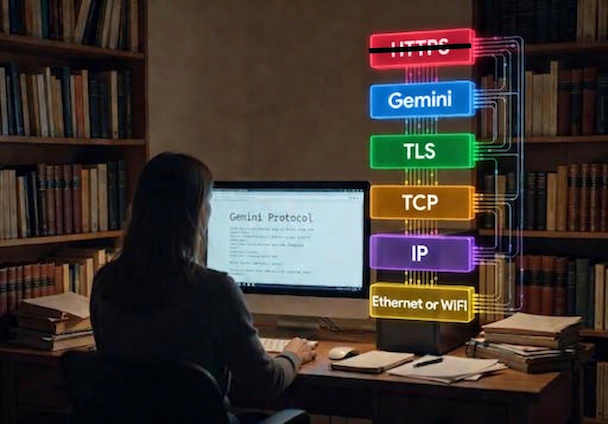
Why bother? Websites have become ugly and annoying. High-IQ people just want information, and they get little videos following their eyes creepily. The ‘Gemini Protocol’, a.k.a. ‘Project Gemini’, is the answer to minimalist prayers. The crafters of Gemini and the resulting gemsites had a smart stratagem: No version 2 ever. Paraphrasing Lao Tzu…
Journey of a thousand unwanted features begins with a single ‘improvement’.
There’s just text, and so it’s clear that gemsites will never catch on with the masses. We are moving to a society of semi-literates. Gemsites find their niche with people who like simple and quiet long-form content. It’s a small but good niche.
Formatting shock
Within the first few minutes of making a gemsite, I was shocked. “Wait, not even italics?!” No. No bold either, and no choice of font; nothing like that. It made me take heed of just how much I had been trained by websites to think about formatting.
All one gets is:
headings
and...
subheadings
Wait! Sorry, I should say, all one gets is:
- headings;
- subheadings;
- bullet-point lists
There are no hyperlinks either. James Corbett would be aghast!4 I became frugal with links. Here’s my thought-process:
- I ask myself: ‘Does the reader really need this?’
- If “yes”, then I put the hyperlink in a footnote.
Speaking of links…
An oddly satisfying reading experience
Hyperlinks get put on a new line. It looks like this:
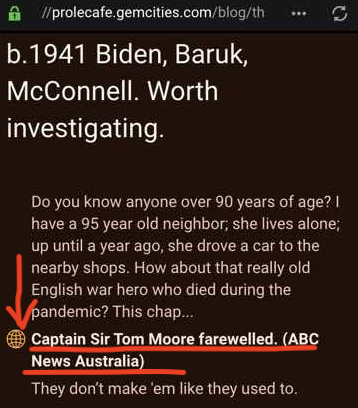
I find it hard to portray the effect this had on me. Hyperlinks have trained our brains. Tim Berners-Lee’s invention of words which lead down mysterious rabbit holes was amazing. It was also a big step forward in distraction. Those hyperlinks say to you: “come look here!” One needs to read a gemsite page to get it. It’s like reading a book. The paragraphs flow easily and one feels more at peace.
Because hyperlinks are on lines of their own, the reader has more of a choice whether to follow them or not. Nowhere is this more of heft than with pictures. As I wrote above, gemsites are 100% text. If you need to see a picture, it’s just a hyperlink to that file. No thumbnail. At first, I thought “this is too extreme.” Now, I love it. Recently, a channel to which I belong on Telegram, shared a video of some Israeli thugs beating up some poor Palestinian in the West Bank. “Nope, not watching that.” I pressed on the next video and then, somehow, my clumsy fingers loaded the violent video; I kind of panicked; I muted my phone and hid it under a cushion. How uncouth Telegram is compared to Gemini.
No code
There’s no Javascript or similar on gemsites. Gemsite-browsers are night-and-day safer than web-browsers. No need for security extensions. It’s nice not to have that issue in the back of one’s mind when clicking on links.
Gemcities
I went for a hosted option at gemcities.com.5 I could have installed a gemsites server on my existing server, but that’s a hassle, and I thought it was a cool, retro touch to use gemcities.com. It’s a nod to geocities.com. If you’re Gen-X, and your family was into computers, you’ll remember that website. Amateurs could easily make webpages and find like-minded people. You can’t get more ‘Small Web’ than geocities.com.
I’m very happy with gemcities.com. The support is excellent.
Better in theory
I mention Geocities, but let’s take off the rose-tinted glasses: Most websites back then were shite.
And this brings me to the downsides. Just like the original Geocities, good content is scarce. Even any content is scarce. The search engines are far from optimal. The ‘Geminispace’ (=World Wide Web) is awesome in theory, but disappointing in practice.
A wasted effort?
Project Gemini came out in 2019. I missed the boat then, so I don’t know for sure, but I’ve heard that it was trendy for a few months in 2020. Here in 2026, new gemsites have slowed to a trickle. There are many dead links.
I’ll keep doing my gemsite, but I get that others might find it futile.
Dip your toes in the water...
You will need to use a gateway. Chrome, Firefox, Brave, etc. do not speak Gemini. It’s just a website which translates a gemsite. Here’s a good one:
There, you can type in any gemsite, like mine, and click ‘go’.
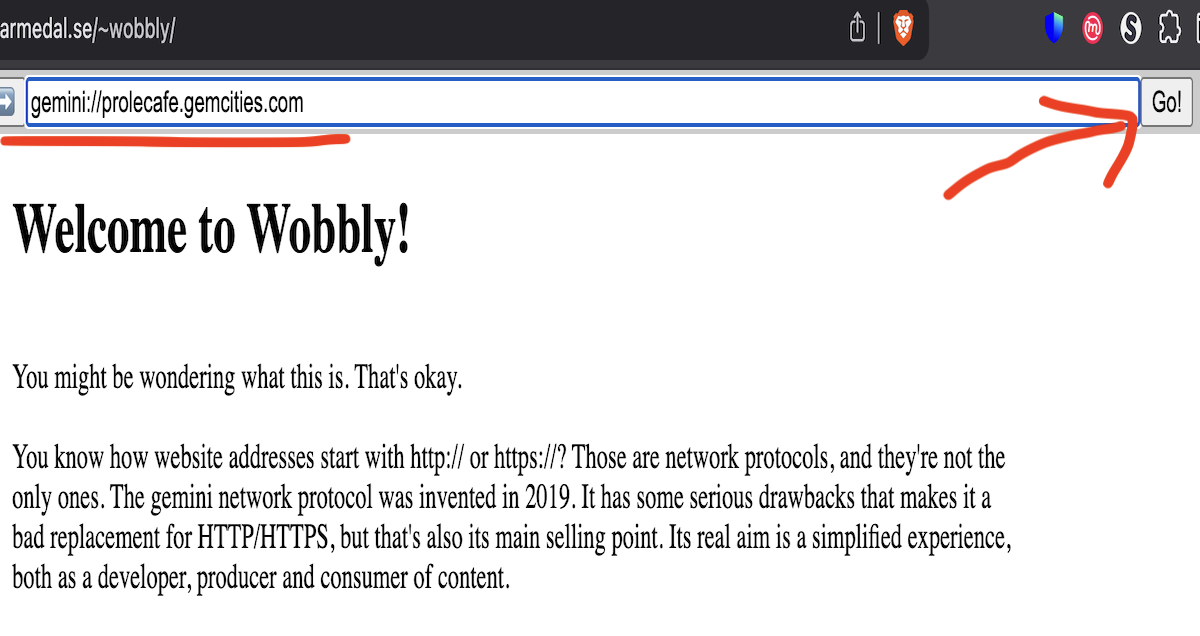
However, gateways make gemsites look bad. Using them is a temporary measure. To give gemsites a fair crack, install a proper Gemini browser. There are lots. I strongly recommend Lagrange.
- By the Stone Temple Pilots (Return)
- A short-duration cassette with two songs on one side, and the same two songs on the other. (Return)
- There is HTTP too, but that is very rare nowadays, because web browsers freak out, so the creator is foolish to scare off 98% of his or her audience. (Return)
- James Corbett, of the Corbett Report, and— one of my favorite podcasts— Solutions Watch, makes a very big deal about using source-material via weblinks carefully. (Return)
- Find me at: prolecafe.gemcities.com. You’ll need a gateway or a gemsites browser. (Return)