Gold Is A Civilized Relic
Things which work really well deserve comebacks. Barges, for example. At the moment, we use trucks on roads, but— things change. It has happened before. The Iron-Age Celts used rivers as the highways, and when the Roman Empire fell, the roads fell into disrepair, and barges made a comeback.1
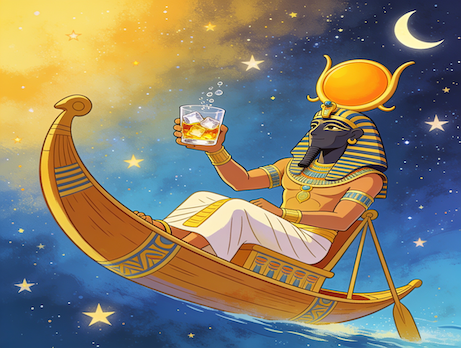
The word ‘barge’ comes from a Celtic root. From this root we also get ‘barque’, a certain type of boat which was Egyptian god Ra’s mode of transport across the sky. Ra is an archetype. He is linked with the sun. So is gold. Write off an archetype at your peril.
The problem with gold
Here’s the issue: Did gold ever work really well?
I don’t disagree with the cryptopians. They point out gold’s flaws.2 Gold...
- ... is hard to transport.
- ... is easy to fake.
The first flaw— call it ‘the physicality flaw’— is that gold is a hassle to move from A to B, but not so much a hassle that thieves won’t nim it.
The second flaw— call it ‘the fakeability flaw’— is that, without some gadget, people can’t tell whether a gold-colored coin is really gold or tungsten.3
These flaws were allegedly fixed, but the fixes made everything even worse. The physicality flaw led to a Gold Standard, whereby pieces of paper stood in for gold. The fakeability flaw led to official stamps of authenticity. “Trust me, peasant, we will never abuse this privilege.” I don’t need to go over what played out in the 20th century. Call me a pessimist, but I say that cheating will always happen sooner or later under such a system.
Satoshi to the rescue
Cryptopians claim that Satoshi Nakamoto solved these problems. Bitcoin (BTC), they claim, is just a better form of money. Bitcoin...
- ... is easy to transport.
- ... is impossible to fake.
This is basically true. This is why I root for cryptocurrency.
All the same, I know that gold is here to stay. God help us if I’m wrong. Civilization would then be dark; dark like never before. I’ll outline two arguments why.
Argument 1: Decentralized gold side-channel
Gold seems like it’s being left behind; “a barbarous relic,” as they say. That’s a mainstream dogma. Luckily for gold, in history, side channels veer off and then come back to the mainstream.
This often happens with technology. For decades, an alternative will stay alive in a niche community; then it will rejoin the mainstream as the situation changes. An example in our own times is electric motors.
I believe that gold, as Internet-enabled, decentralized money, will take longer to develop . At first, the mainstream will take up the same old, cheaty ways. Maybe something like the Gold Standard? Meanwhile, some freedom-lovers will form a side channel. One must not be so smug as to think the same tech underlying bitcoin won’t ever be ported to gold. Let’s look at gold’s two big flaws again:
The Physicality Flaw
Solution: Tokenization allows gold to be sent anywhere instantly over the Internet.
The Fakeability Flaw
Solution: LIBS tech will get much better and cheaper. (Look here . This device is the equivalent of an 80s Motorola brick.)
“But tokenization of gold is necessarily centralized.”
If bitcoin is tequila, tokenized gold is scotch. Wait for its tech to mature. It won’t outdo something like monero (XMR) in the field of decentralized digital cash, but it can come much closer than you think. LIBS tech can be linked to SSL certificates and node-relay verification. Big topic, but I can imagine a stablecoin with thousands of independent gold-holders.
Argument 2: Gold as archetype
We think of kings, queens, and wizards as relics of the past. Clothed in the forms of the past, they are, but in truth they are archetypes and will be with human beings so long as we are human beings.
Gold too is an archetype. More accurately, it pairs with the sun as an archetype.
A human being is not homo economicus, some price-calculating robot. We have culture. Our products have stories behind them. “The pot of stock certificates at the end of the rainbow” doesn’t quite have the same ring. Gold is archetypical in our fairy tales.
From Egyptian Pharaohs to Anglo-Saxon warlords, being buried with gold jewellery heralded power and status. The Egyptian sun god Ra was often paired with the hieroglyph for gold. Three words go together archetypically: sun, king, gold.
The link with the sun is very important. It’s easy to see that the color of gold matches the sun. The glint of gold in rivers seemed to the ancients like literally catching a tiny piece of the sun. The sun is the ultimate compass of our lives, because it guides the passing of time. One might say that the sun represents stability, just like the king archetype. Hence, gold is associated with stability. The river made ancient trade possible. The river is also the archetype of change. Stability versus change: finding fragments of stability in a river had symbolic heft.
Gold is not just a precious metal. Why do you think the price of gold skyrockets in times of great strife? It’s not homo economicus making that calculation. It’s homo sapiens making an ancient, subconscious prayer for stability.
Takeaways
- Gold as money has flaws.
- Past fixes for these flaws made things worse.
- A technological side-channel will work on proper, decentralized fixes for these flaws.
- Gold is an essential part of civilization because it is an archetype meaning stability.
- Ra’s Scotch would make an excellent brand.
- To be accurate, this was just the western Roman Empire, mainly in Britain and France. I’m not sure what happened in the eastern Roman Empire, a.k.a. the Byzantine Empire, which lasted until the 15th century AD. Also, it’s a moot point whether barges fell out of favor. It’s better to say that in the Roman times, people had a choice of road or river, and then it went back to just river. (Return)
- I’m a silverbug and think silver is a better form of money for the masses. It’s best to leave that out of the discussion. Silver will never take gold’s place as the main store of value. (Return)
- Tungsten, because, otherwise, people would tell by weight that it’s not gold. (Return)